
If you are in danger now, call 911. The National Domestic Violence Hotline is free, confidential and open 24 hours, at 1-800-799-7233. If someone checks your phone or computer, consider reading this on a device they have never had access to. The quick-exit button only switches the screen. It does not erase your browsing history or stop someone who is monitoring your device (NNEDV Safety Net).
Domestic violence · Statistics updated October 2026
Domestic violence is common and too often deadly. The CDC’s newest national survey found that more than 1 in 3 U.S. women and more than 1 in 6 men have experienced sexual violence, physical violence or stalking by an intimate partner. In Missouri, courts received more than 43,000 petitions for adult orders of protection in fiscal year 2025. In 2020, the last year of data the Violence Policy Center ranked, Missouri tied for sixth in the nation for women and girls killed by men.
This page collects current statistics from government agencies and peer-reviewed research, with the year and source for each figure. It covers how often abuse happens, how often it is reported, who is killed, teens and children, and Missouri’s own numbers.
- How Common Is Domestic Violence in the United States?
- How Much Domestic Violence Is Reported to Police?
- What Police Reports Show
- How Many People Are Killed in Domestic Violence?
- Warning Signs Linked to Domestic Violence Homicide
- Missouri Domestic Violence Statistics
- Who Is Most Affected by Domestic Violence?
- Teen Dating Violence Statistics
- Children and Domestic Violence
- Common Misconceptions About Domestic Violence
- Are Domestic Violence Rates Going Up?
- Why Domestic Violence Statistics Vary So Much
- What Does Domestic Violence Cost?
- What These Numbers Mean If You Are in Missouri
- Where to Get Help in Missouri
- How Bardol Law Firm Helps
- Frequently Asked Questions
- Using These Statistics
Key Domestic Violence Statistics
How Common Is Domestic Violence in the United States?
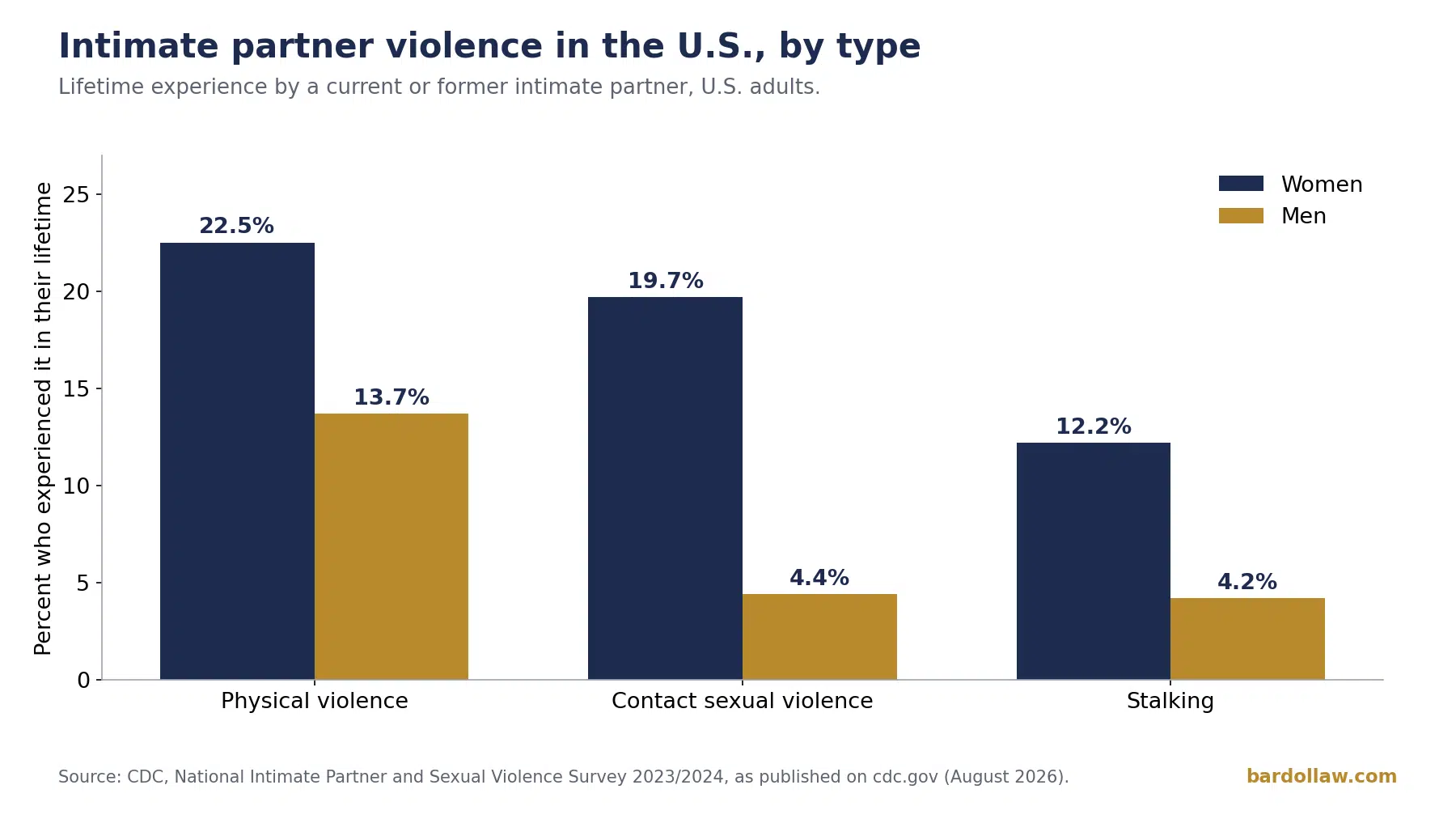
A major national survey of this is the CDC’s National Intimate Partner and Sexual Violence Survey. It asks adults directly about their experiences, whether or not they ever told the police. Its 2023/2024 results, which the CDC published on its intimate partner violence page in August 2026, found the following.
More than 1 in 3 women (nearly 43.5 million) and more than 1 in 6 men (20.7 million) have experienced contact sexual violence, physical violence or stalking by an intimate partner during their lifetimes.
Among women. Nearly 1 in 4 experienced physical violence by a partner (22.5 percent), about 1 in 5 contact sexual violence (19.7 percent), and about 1 in 8 were stalked (12.2 percent).
Among men. About 1 in 7 experienced physical violence by a partner (13.7 percent), nearly 1 in 23 contact sexual violence (4.4 percent), and almost 1 in 24 were stalked (4.2 percent).
Nearly 1 in 3 women and about 1 in 8 men also reported at least one related impact. Examples include injury, missing work or school, fear for their safety, needing medical care, or contacting police.
“Intimate partner” here means a current or former spouse or dating partner. The survey also measures psychological aggression, the use of words and behavior to harm or control a partner, which is not included in the figures above.
Abuse often starts young. In the CDC’s 2016/2017 survey, about 16 million women and 11 million men said they first experienced intimate partner violence before age 18.
Why you may see “nearly half” elsewhere. Many websites still cite the 2016/2017 survey, which reported that 47.3 percent of women and 44.2 percent of men had experienced intimate partner violence (National Sexual Violence Resource Center summary). The CDC significantly revised the survey for 2023/2024, moving from telephone interviews to a web-based design, and says comparisons with earlier years are not recommended (CDC NISVS FAQ).
Facing an order of protection, or asking for one? Get clear answers about your case.
Spend a full hour with an experienced Bardol Law Firm attorney going through the details of your case, understanding your rights, and leaving with clear next steps. It is personalized guidance you can use whether or not you hire us afterward.
$300 · One full hour with an attorney · No obligation to retain our firm
How Much Domestic Violence Is Reported to Police?
The Bureau of Justice Statistics’ National Crime Victimization Survey interviews people age 12 and older about crimes, whether or not they were reported. For 2024, it estimated 1,110,040 domestic violence victimizations, meaning nonfatal violent crimes by an intimate partner or another family member. Of those, 782,900 were by an intimate partner (Bureau of Justice Statistics, 2024 key findings). A victimization is an incident, not a person, so one person can account for more than one.
In 2024, 64 percent of those domestic violence victimizations and 61 percent of intimate partner victimizations were reported to police, so roughly a third were not, by our calculation. These figures cover violent crimes such as assault. The survey does not measure emotional abuse, financial control or other coercive behavior.
What Police Reports Show
In February 2026, the FBI released a special report on violent crimes involving domestic relationships. It draws on 2020 through 2024 reports from law enforcement agencies that take part in its National Incident-Based Reporting System (FBI). The FBI’s definition of a domestic relationship includes current and former spouses and partners, but also parents, children and other family relationships. The figures count crimes reported to participating agencies, so they are not a complete count of all abuse.
11,466 murder victims in domestic relationships over the five years, and 1,109,797 victims of other violent crimes (rape, robbery and aggravated assault), of whom 694,552 were injured.
A rising share of violent crime. Domestic relationships accounted for 25.6 percent of reported violent crimes in 2020 and 27.5 percent in 2024. Aggravated assault was the most likely to be domestic, averaging 31.0 percent.
74.5 percent of victims were female, and 77.1 percent of offenders were male.
79.6 percent of domestic violent crimes happened in a home, compared with 41.1 percent of other violent crimes.
Hands, fists and feet were the most common weapons. A firearm was present in 13.7 percent of domestic violent crime incidents, compared with 32.6 percent of other violent crimes. That figure covers all reported violent crimes. Firearms play a much larger role in domestic homicides, as the next section shows.
Alcohol use was reported in 12.5 percent of domestic incidents, nearly double the 6.6 percent for other violent crimes.
How Many People Are Killed in Domestic Violence?
Homicide data comes from police reports to the FBI and from death records. Two major sources stand out.
CDC death data from 27 states (2015). The relationship between victim and suspect was unknown in 52.3 percent of homicides. Where it was known, a current or former spouse or intimate partner was the suspect in 21.5 percent of all homicides and 51.4 percent of homicides of women. Intimate partner violence was a known circumstance in 45.4 percent of homicides of women (CDC, MMWR).
2,381 women and girls were murdered by men in single-victim, single-offender incidents in 2024, a rate of 1.4 per 100,000. That figure comes from the Violence Policy Center’s analysis of FBI data, released September 16, 2026. Where the relationship could be identified (2,079 victims), 86.9 percent knew their killer. 1,040 were wives, common-law wives, ex-wives or girlfriends of the men who killed them. That undercounts partner homicide, because the FBI data does not separately identify ex-girlfriends. Where the weapon was known, 63.4 percent were shot.
The same study found the rate of women killed by men fell between 1996 and 2014. It then rose from 1.2 per 100,000 in 2019 to 1.4 in 2022, and held at 1.4 through 2024.
Homicide During Pregnancy
A study of death records from 47 states, 2018 through 2022, found 637 homicides of women who were pregnant or had recently given birth. That is 5.33 per 100,000 live births. Firearms were used in 78 percent, and 51 percent were associated with intimate partner violence (Bright and colleagues, 2025). Earlier national research found pregnant and postpartum women faced a 16 percent higher risk of homicide than other women of reproductive age in 2018 and 2019 (Wallace and colleagues, 2021).
Warning Signs Linked to Domestic Violence Homicide
Researchers have compared women killed by abusive partners with abused women who survived, to find what set the deadliest cases apart. These case-control studies describe risk across groups of women, not a prediction for any one person.
Gun access. One 11-city study compared 220 women killed by intimate partners with 343 abused women who survived. An abuser’s access to a gun was associated with about five times the odds of the woman being killed (adjusted odds ratio 5.38). That accounts for other risk factors measured before the incident (Campbell and colleagues, American Journal of Public Health, 2003).
Leaving a controlling partner. The same study linked estrangement, especially from a controlling partner, to higher risk. Never having lived together and a prior domestic violence arrest were linked to lower risk.
Strangulation. Prior non-fatal strangulation was reported by 43 percent of women killed by partners, 45 percent of women who survived attempted homicides, and 10 percent of other abused women. It was associated with about 7.5 times the odds of being killed and about 6.7 times the odds of an attempted homicide (Glass and colleagues, Journal of Emergency Medicine, 2008).
Strangulation needs medical attention even without visible marks. Many strangulation victims show no visible injuries but can have life-threatening internal injuries, including brain injury, damage to the carotid arteries and stroke, sometimes appearing later (New Jersey State Police). In Missouri, knowingly causing physical injury to a domestic victim by choking or strangulation is domestic assault in the second degree, a class D felony, under section 565.073.
Missouri Domestic Violence Statistics
Orders of Protection in Missouri Courts
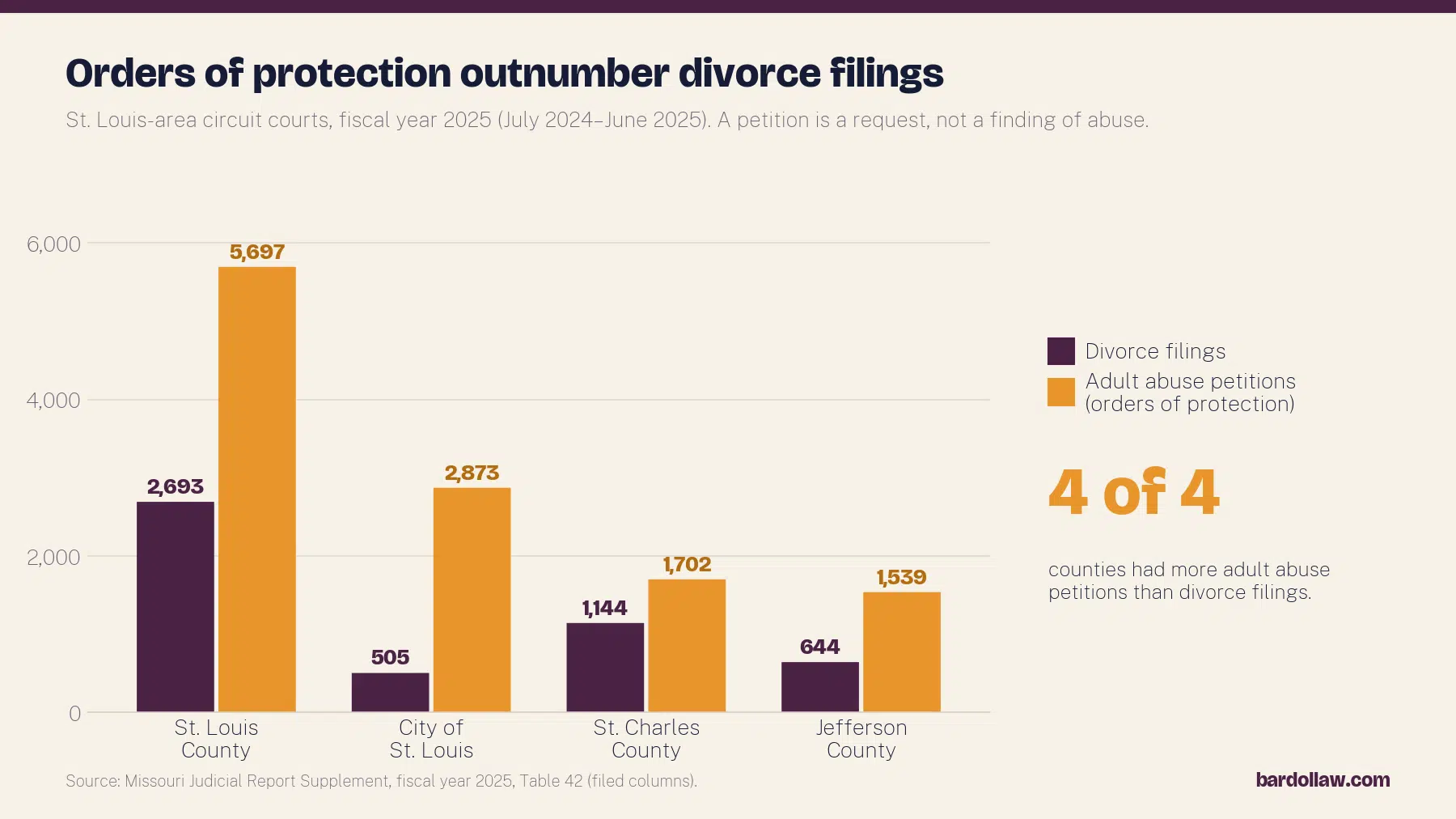
In fiscal year 2025, Missouri circuit courts received 43,112 adult abuse petitions, the court category for adult orders of protection, compared with 19,315 divorce filings. St. Louis County received 5,697 petitions, the City of St. Louis 2,873, St. Charles County 1,702 and Jefferson County 1,539 (Missouri Judicial Report Supplement, fiscal year 2025, Table 42). In all four courts, adult abuse petitions outnumbered divorce filings. A petition is a request, not a finding of abuse or an order granted. Missouri’s law also allows petitions for stalking or sexual assault by people outside a domestic relationship. Our Missouri family law statistics page has more on what Missouri courts handle.
Missouri Ranks Among the Highest for Women Killed by Men
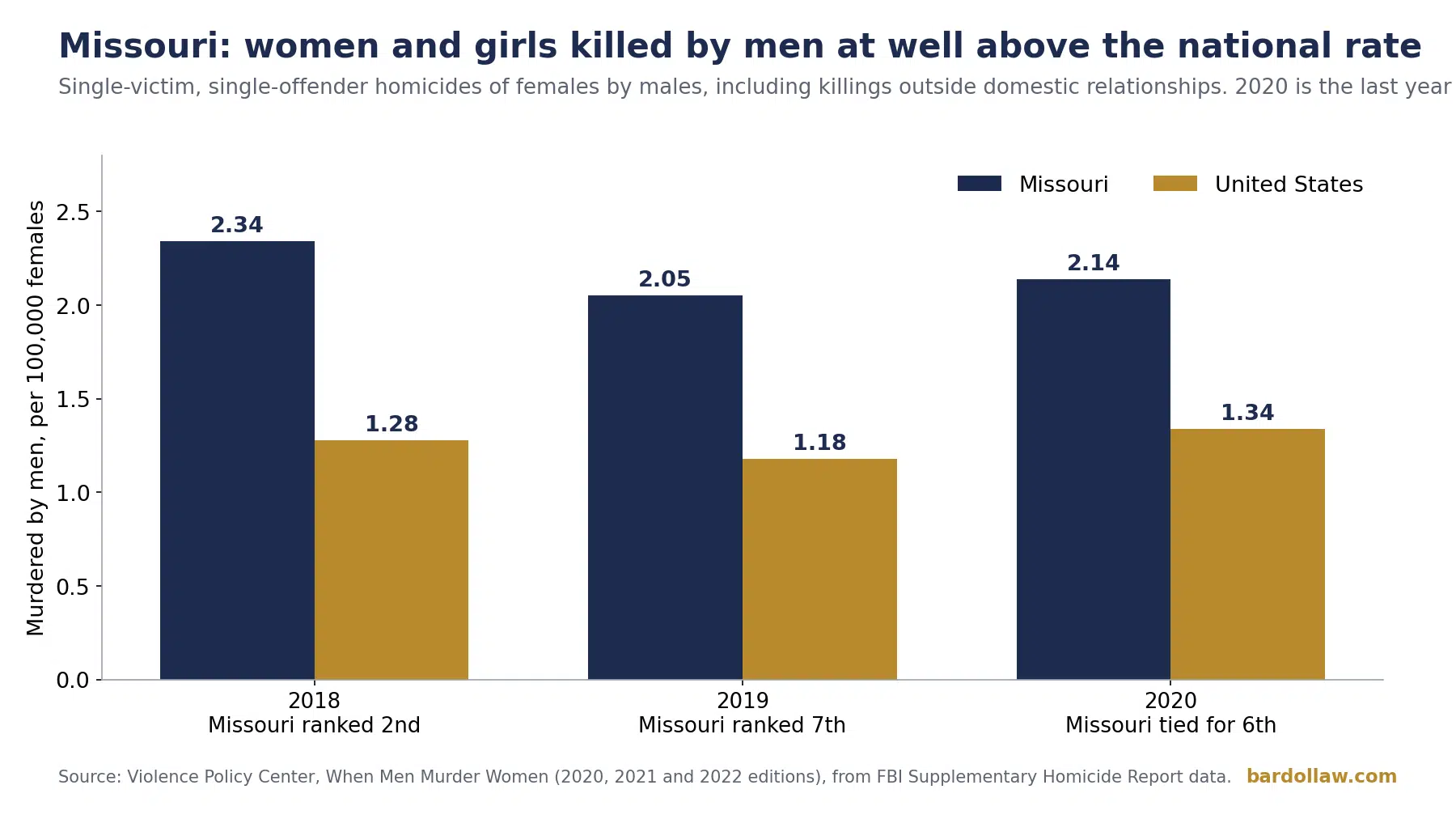
Editions of the Violence Policy Center’s annual study published before 2023 ranked the states by their rate of women and girls murdered by men in single-victim, single-offender homicides. These rankings include killings outside domestic relationships, so they are not a measure of domestic violence homicide alone. In the last three years of data ranked, Missouri placed in the top seven each time.
2018, second in the nation. 73 women and girls were murdered by men in Missouri, a rate of 2.34 per 100,000, compared with 1.28 nationally. Where the relationship to the killer was known, 92 percent knew him, and 56 percent of those were wives or intimate partners. Eighty percent of the women killed by an intimate partner were shot (2020 edition).
2019, seventh. 64 were murdered, a rate of 2.05 per 100,000, compared with 1.18 nationally. Where the relationship was known, 89 percent knew their killer, and 65 percent of those were wives or intimate partners. Where the weapon was known, 81 percent were shot (2021 edition).
2020, tied for sixth. 67 were murdered, a rate of 2.14 per 100,000, compared with 1.34 nationally. Where the relationship was known, 94 percent knew their killer, and 65 percent of those were wives or intimate partners. Where the weapon was known, 78 percent were shot (2022 edition).
Beginning with 2021 data, the Violence Policy Center stopped ranking the states. The FBI had changed how it collects crime data, which made state data less reliable (Violence Policy Center).
One Day in Missouri’s Domestic Violence Programs
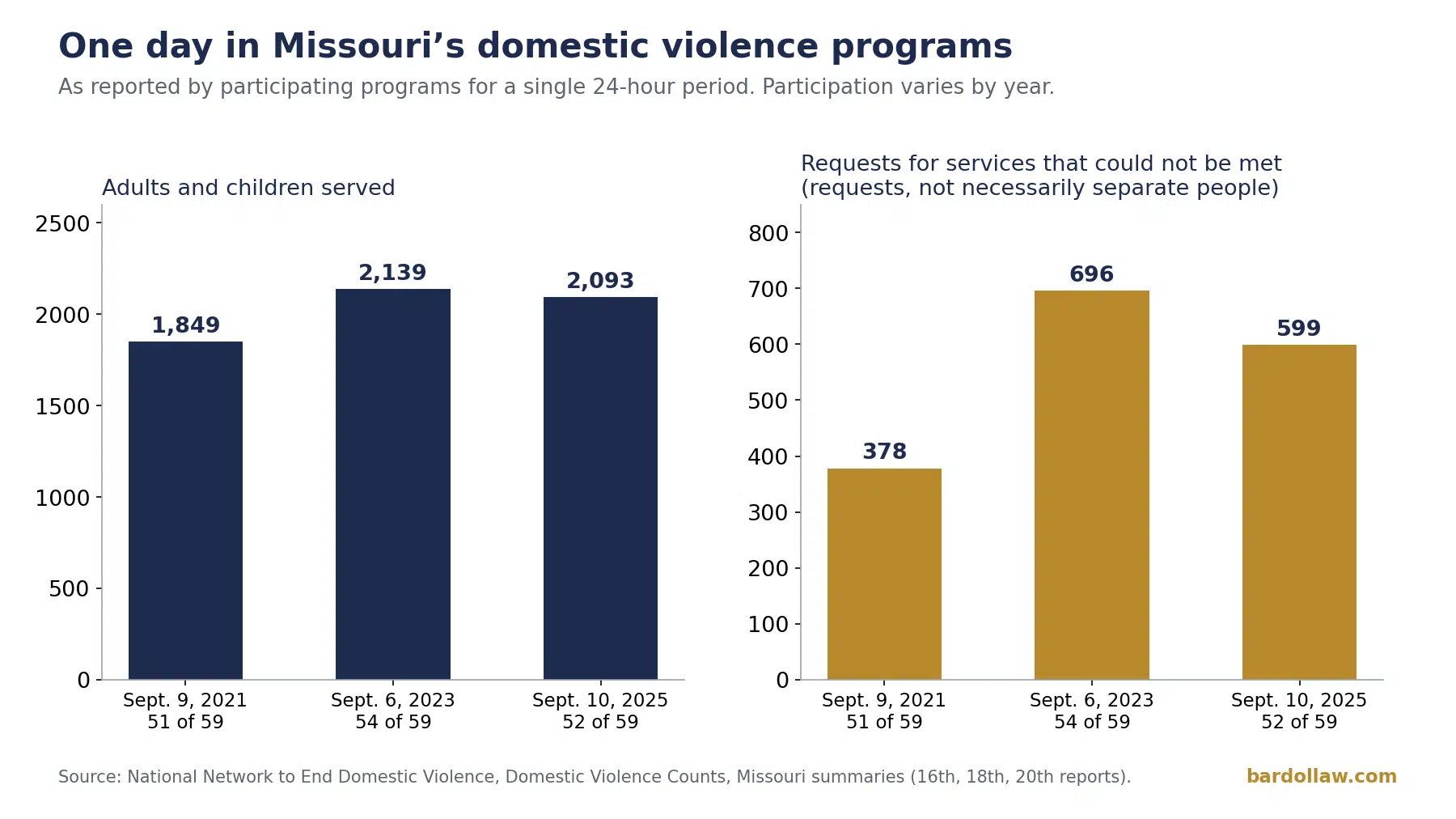
Each year, the National Network to End Domestic Violence asks domestic violence programs to report the people they served over a single 24-hour period. On September 10, 2025, 52 of Missouri’s 59 programs took part, and reported the following for that one day.
2,093 adults and children were served. Of them, 1,337 found refuge in emergency shelters, transitional housing, hotels, motels or other housing, and 756 received services such as transportation, housing support, legal support and therapy.
433 hotline contacts came in, more than 18 an hour.
599 requests for services could not be met because programs lacked resources, funding or staff. About 43 percent were for shelter or other housing. Requests are not necessarily separate people.
44 percent of participating programs reported providing court accompaniment or legal support that day.
Earlier counts found 1,849 people served and 378 unmet requests in 2021, with 51 programs participating, and 2,139 served and 696 unmet in 2023, with 54 programs. Because participation changes, these counts show the size of the need rather than a trend.
Police-Reported Domestic Violence in Missouri
Missouri law enforcement agencies report domestic violence incidents to the Missouri State Highway Patrol whether or not an arrest is made. The Patrol’s definition is broader than “intimate partner.” It covers spouses and former spouses, people with a child in common, relatives by blood or marriage, and people who live or have lived together. An incident is reported when an officer believes a dispute crossed the line into harassment, stalking, coercion, assault, sexual assault, battery or unlawful imprisonment (Highway Patrol domestic violence data).
The Patrol’s most recent statewide table posted online is for 2014, when Missouri agencies reported 40,340 domestic violence incidents, about 110 a day by our calculation. The largest relationship categories that year, in the Patrol’s terms, were people who live together but are not married (8,802), blood relatives (8,197), spouses (7,663), people in a “social relationship” (7,574) and people with a child in common (4,620). Current counts by city and county are in the Patrol’s interactive Show-Me Crime system.
Missouri law also requires the Highway Patrol to compile an annual report of homicides and suicides related to domestic violence, under section 455.545. The report goes to the governor and legislative leaders by March 1 each year.
Who Is Most Affected by Domestic Violence?
Women. More than 1 in 3 women have experienced intimate partner violence in their lifetimes, compared with more than 1 in 6 men. Where the relationship was known, about half of women murdered were killed by a current or former spouse or intimate partner (CDC).
Black women. In 2024, Black women were murdered by men at a rate of 2.9 per 100,000, more than twice the rate for white women (1.2). Black women made up 14.1 percent of the female population but 30.3 percent of women killed by men (Violence Policy Center).
Bisexual, lesbian and gay adults. In the CDC’s 2016/2017 survey, bisexual women reported significantly higher lifetime rates of intimate partner violence and sexual violence than heterosexual women. Gay and bisexual men reported significantly higher lifetime rates of sexual violence than heterosexual men. The CDC’s report also cites other research finding transgender people at significantly higher risk of intimate partner violence (CDC report on victimization by sexual identity).
Men, too. About 1 in 6 men has experienced intimate partner violence (CDC). Men can seek the same orders of protection in Missouri as anyone else.
Teen Dating Violence Statistics
The CDC’s Youth Risk Behavior Survey asks high school students who dated in the past year about violence by a dating partner. In 2021, the CDC reported the following among those students (CDC).
About 1 in 12 experienced physical dating violence.
About 1 in 10 experienced sexual dating violence.
Female students experienced higher rates of physical and sexual dating violence than male students, and students identifying as lesbian, gay, bisexual, transgender or queer, or unsure of their gender identity, experienced higher rates than heterosexual students.
Police reports show the same pattern. In 2024, law enforcement agencies reported 70,523 incidents of teen relationship violence to the FBI. In each, the victim or offender was 13 to 19, and the two were current or former boyfriend, girlfriend or spouse. Of the victims, 79.2 percent were female. Simple assault made up 60.8 percent of the offenses, and injuries were reported for 47.8 percent of victims (FBI, 2026).
Children and Domestic Violence
The federal National Survey of Children’s Exposure to Violence was conducted in 2008 with 4,549 children and caregivers. It found that about 1 in 15 children (6.6 percent) had been exposed to physical violence between their parents, or between a parent and that parent’s partner, in the past year. Eleven percent had been exposed to some form of family violence that year, and 26 percent at some point in their lives (Office of Juvenile Justice and Delinquency Prevention, 2011). These are 2008 data. In Missouri custody cases, a history of abuse is one of the factors a court must weigh, as explained below.
Common Misconceptions About Domestic Violence
“Choking is a minor form of abuse.” Not true. Prior strangulation was associated with about 7.5 times the odds of being killed by a partner (Glass and colleagues). It can cause internal injuries without visible marks. In Missouri, knowingly injuring a domestic victim by choking or strangulation is a felony (section 565.073).
“Leaving ends the danger.” Not true. Research links estrangement, especially from a controlling partner, to higher homicide risk (Campbell and colleagues). Planning a safe exit with an advocate matters for that reason.
“Women are usually killed by strangers.” Not true. In 2024, where the relationship could be identified, 86.9 percent of women and girls murdered by men knew their killer (Violence Policy Center).
“Men are not victims.” Not true. More than 1 in 6 U.S. men have experienced intimate partner violence (CDC).
“Teen relationships are too young for real abuse.” Not true. In 2021, about 1 in 12 high school students who dated experienced physical dating violence, and about 1 in 10 sexual dating violence (CDC).
Abuse affects custody, parenting time and safety planning. Get advice on your situation.
For $300, sit down one-on-one with an experienced Bardol Law Firm family law attorney. We will dig into your specific situation, explain your rights and options in plain English, and map out practical next steps. This is a working strategy session, not a sales pitch, and you leave with real value whether or not you hire us.
$300 · One full hour with an attorney · No obligation to retain our firm
Are Domestic Violence Rates Going Up?
The honest answer depends on which number you mean. Share of reported violent crime. Domestic relationships rose from 25.6 percent of violent crimes reported to the FBI in 2020 to 27.5 percent in 2024 (FBI). Women killed by men. The national rate fell from 1996 to 2014. It rose from 1.2 per 100,000 in 2019 to 1.4 in 2022, and held there through 2024 (Violence Policy Center). Demand for help in Missouri. Programs still could not meet hundreds of requests on a single day in 2025 (NNEDV). Overall prevalence. The CDC changed its survey design for 2023/2024 and advises against comparing those results with earlier years, so survey results are not a reliable trend line (CDC).
Why Domestic Violence Statistics Vary So Much
Different sources measure different things, which is why one website says “1 in 3” and another says “nearly half.” Before relying on a number, ask what kind it is.
Population surveys (CDC, adults, 2023/2024 data) ask people directly, so they capture abuse that was never reported, including stalking and contact sexual violence. They depend on question wording and survey version.
Crime victimization surveys (Bureau of Justice Statistics, ages 12 and older, 2024 data) estimate nonfatal violent crimes in a year, reported or not. They count incidents, not people.
Police reports (FBI, from participating agencies, 2020 to 2024, and the Missouri State Highway Patrol) count only crimes someone reported. Both definitions include family members, not only partners.
Court filings (Missouri courts, fiscal year 2025) count petitions, not proven abuse or orders granted.
Program counts measure people who reached a shelter or advocate, which depends on available services as much as on need.
Homicide data (Violence Policy Center from FBI reports, 2024, and CDC death data, 2015) depends on agencies reporting and on whether the relationship to the killer was recorded. It is often unknown.
Each figure on this page names its source and year so you can judge it for yourself.
What Does Domestic Violence Cost?
The CDC estimates the lifetime economic burden of intimate partner violence in the United States, across everyone who has experienced it, at $5.6 trillion. It is not an annual cost. That includes medical care, lost work and criminal justice costs. Over a lifetime, it comes to nearly $135,000 per female victim and over $30,000 per male victim (CDC).
What These Numbers Mean If You Are in Missouri
Statistics describe millions of people. If you are one of them, the more useful question is what Missouri law lets you do.
Orders of protection. Under Missouri’s domestic violence law, Chapter 455, you can ask a court to protect you from abuse by a family or household member or an intimate partner, including attempts or threats. You can also seek an order against stalking, cyberstalking or sexual assault by anyone (Missouri Courts adult abuse forms). Our pages explain adult orders of protection, ex parte orders, full orders and child protection orders.
Custody. Missouri presumes that equal or approximately equal parenting time is in a child’s best interests. A finding that a pattern of domestic violence has occurred is one way that presumption can be overcome. A history of abuse is also a factor the court must weigh. If a court finds a pattern of domestic violence but still gives custody to the abusive parent, it must explain why in written findings. Whenever a court finds domestic violence or abuse occurred, it must also make specific findings. They must show the custody or visitation arrangement best protects the child and the victim from further harm (section 452.375). Our child custody and 50/50 custody pages cover how this works.
Preparing for court. Courts decide cases on evidence, not statistics. Our tips for preparing for a domestic violence hearing explain what to gather.
Protection orders and custody cases where abuse is part of the picture are what we handle every day.
That is why Bardol Law Firm handles family law and nothing else. We spend every day in these courts, and we explain things in plain English. So we built a one-hour strategy session with you, an experienced attorney and your actual case, with clear next steps by the end.
$300 · One full hour with an attorney · No obligation to retain our firm
Where to Get Help in Missouri
Emergency. Call 911.
National Domestic Violence Hotline. 1-800-799-7233, 24 hours a day, free and confidential. You can also text START to 88788. Deaf services videophone 855-812-1001.
St. Louis-area crisis lines, shelters, free legal help and where to file. Our Domestic Violence Corner lists them for St. Louis County, the City of St. Louis, St. Charles County and Jefferson County.
Elsewhere in Missouri. The Missouri Coalition Against Domestic and Sexual Violence lists programs statewide on its How to Get Help page.
How Bardol Law Firm Helps
Bardol Law Firm handles family law and nothing else, in St. Louis County, the City of St. Louis, St. Charles County and Jefferson County. We help people seek and respond to orders of protection, and we handle divorce and custody cases where abuse is part of the picture, including how it affects parenting time. Before joining the firm, attorney Ann Bruntrager interned with Legal Advocates for Abused Women in St. Louis (now part of Crime Victim Center), and attorney Anna Palmer volunteered with St. Louis Survivors Legal Support. Our domestic violence practice page explains the services we offer.
Not sure how this applies to your situation?
Bardol Law Firm handles family law and nothing else, in St. Louis County, St. Louis City, St. Charles County and Jefferson County. We return calls from potential clients as quickly as possible, and usually within minutes.
Frequently Asked Questions
What percentage of women experience domestic violence?
More than 1 in 3 U.S. women have experienced sexual violence, physical violence or stalking by an intimate partner in their lifetimes, according to the CDC’s 2023/2024 survey.
What percentage of domestic violence is reported to police?
About 64 percent of nonfatal domestic violence victimizations in 2024, according to the Bureau of Justice Statistics’ estimate, and 61 percent for intimate partner violence. That measures violent crimes, not every form of abuse.
How many women are killed by intimate partners each year?
No single national count is complete. In 2024, 1,040 women and girls were murdered by a husband, ex-husband or boyfriend in single-victim, single-offender homicides reported to the FBI, according to the Violence Policy Center. That undercounts partner homicide, because ex-boyfriends cannot be identified in the data and many relationships go unrecorded.
Is strangulation a sign of homicide risk?
Yes. In a peer-reviewed case-control study, prior non-fatal strangulation was associated with about 7.5 times the odds of an abused woman later being killed by her partner. Strangulation also warrants medical attention, because it can cause internal injuries without visible marks. In Missouri, knowingly injuring a domestic victim by choking or strangulation is a felony.
Does Missouri have a high rate of women killed by men?
It did in the last years ranked. Missouri ranked second in 2018, seventh in 2019 and tied for sixth in 2020 for women and girls murdered by men, a measure that includes killings outside domestic relationships. The Violence Policy Center has not ranked states since, because of changes in FBI data collection.
How common is teen dating violence?
About 1 in 12 high school students who dated experienced physical dating violence in the past year, and about 1 in 10 experienced sexual dating violence, according to the CDC’s 2021 survey.
Are men victims of domestic violence?
Yes. More than 1 in 6 U.S. men have experienced sexual violence, physical violence or stalking by an intimate partner, according to the CDC.
Where can I find current Missouri domestic violence data?
For court filings, the Missouri Judicial Report Supplement counts adult abuse petitions each fiscal year. For police-reported incidents, use the Missouri State Highway Patrol’s Show-Me Crime system. For services, the Missouri Coalition Against Domestic and Sexual Violence publishes annual statistics on its research page. The National Network to End Domestic Violence also publishes a Missouri summary of its one-day count.
Using These Statistics
This page gives general information as of October 2026 and is not legal advice. Statistics are reported as published by the sources linked, and each source defines and counts domestic violence differently.
The choice of a lawyer is an important decision and should not be based solely upon advertisements.