
Divorce after 50 · Statistics updated October 2026
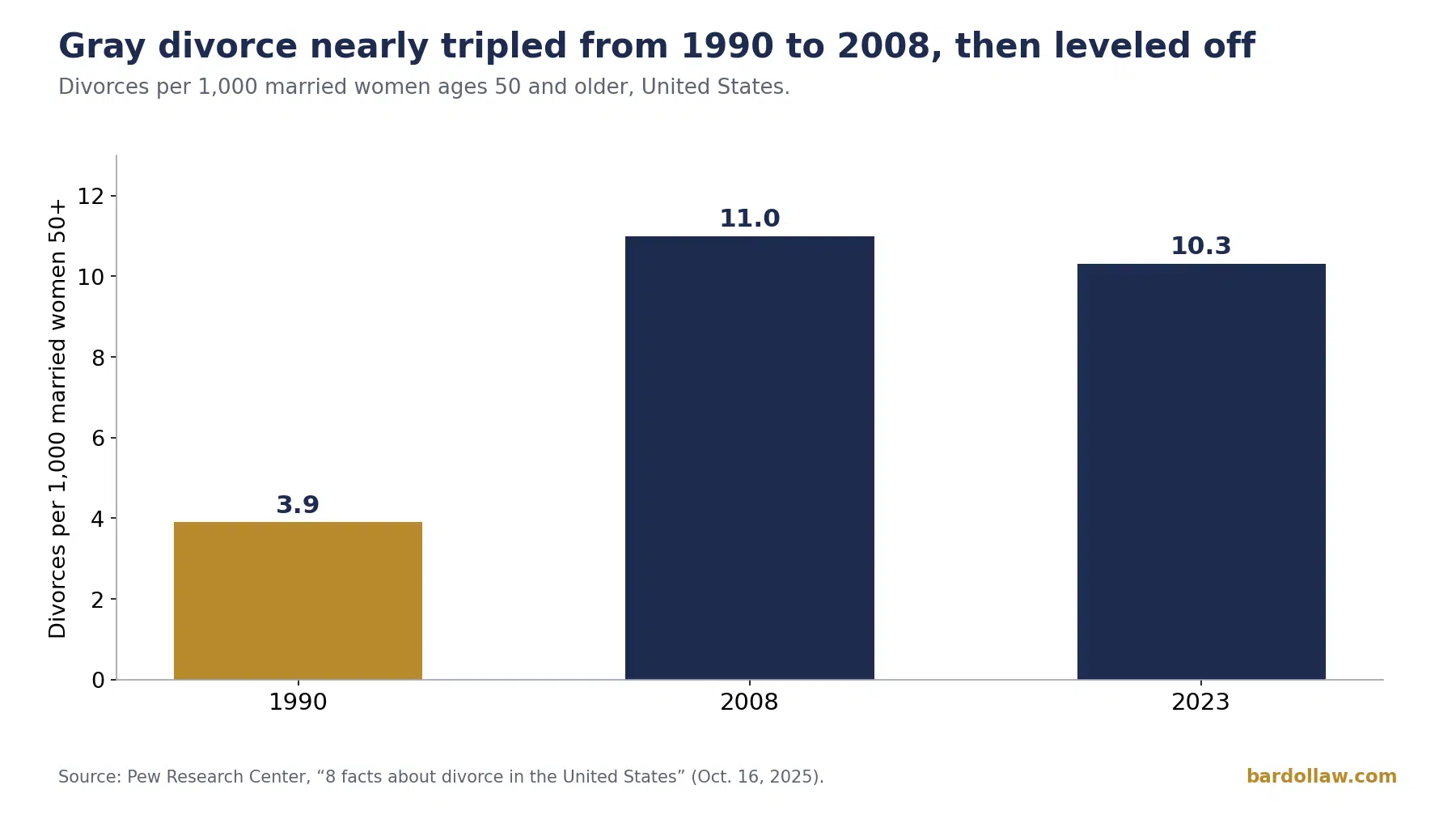
Divorce after 50, often called gray divorce, nearly tripled between 1990 and 2008 and has stayed near that level since. In 1990 there were 3.9 divorces for every 1,000 married women 50 and older, and by 2023 the rate was 10.3, while divorce among younger adults fell. More than 1 in 3 people divorcing in the U.S. are now 50 or older, and a gray divorce cuts women’s standard of living by nearly half.
This page collects the most current research on divorce after 50, with the source and year for each figure, and explains what Missouri law means for people ending a long marriage here.
- What Is Gray Divorce?
- How Common Is Gray Divorce?
- What Share of Divorces Involve People Over 50?
- How Long Were the Marriages That Ended?
- Remarriage and Gray Divorce
- Is Gray Divorce Still Increasing?
- The Financial Cost of Divorce After 50
- What Missouri Law Says About Divorce After 50
- Why Gray Divorce Statistics Differ
- How Bardol Law Firm Helps
- Frequently Asked Questions
- Using These Statistics
Key Gray Divorce Statistics
What Is Gray Divorce?
Gray divorce means divorce among adults 50 and older. Sociologists Susan Brown and I-Fen Lin of Bowling Green State University used the term in a 2012 study, and their National Center for Family & Marriage Research remains the main source of national data on the subject (Brown and Lin, 2022). The Pew Research Center uses the same age definition. Many people also search for it as “grey divorce” or “divorce after 50.”
Thinking about divorce after a long marriage? Start with the questions that matter at this stage.
Spend a full hour with an experienced Bardol Law Firm attorney going through the details of your case, understanding your rights, and leaving with clear next steps. It is personalized guidance you can use whether or not you hire us afterward.
$300 · One full hour with an attorney · No obligation to retain our firm
How Common Is Gray Divorce?
According to the Pew Research Center, the divorce rate for married women 50 and older moved like this.
1990. 3.9 divorces per 1,000 married women 50 and older.
2008. 11.0, nearly three times the 1990 rate.
2023. 10.3, roughly the same level, after staying relatively stable since 2008.
Over the same period, the divorce rate for people 15 to 49 stayed level until 2008 and then fell. The overall U.S. divorce rate has dropped to 14.4 per 1,000 married women, from a peak of 22.6 around 1980.
Divorce after 65. Among people 65 and older, the divorce rate roughly tripled between 1990 and 2015, reaching 6 per 1,000 married people, according to an earlier Pew analysis.
What Share of Divorces Involve People Over 50?
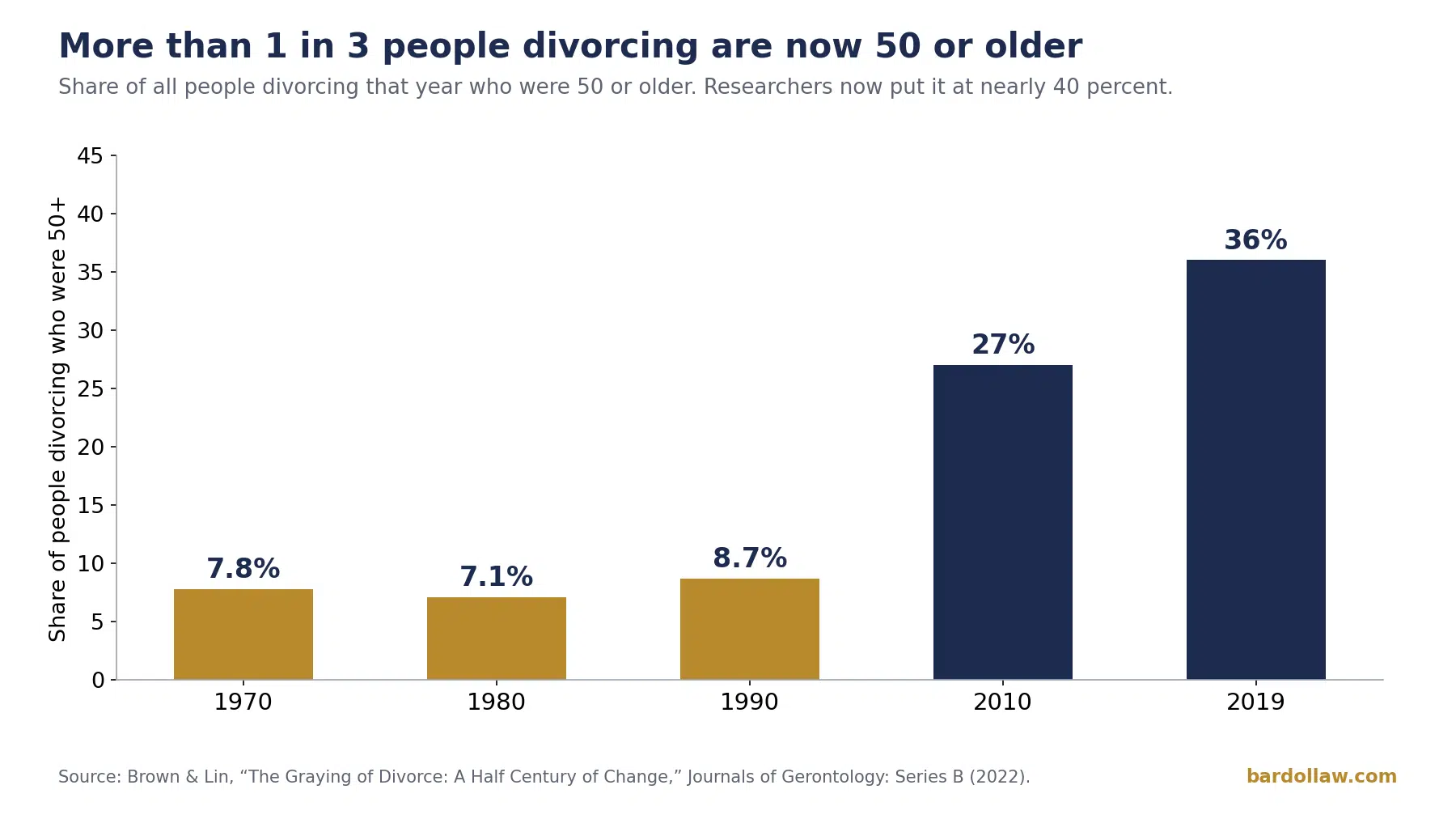
Because younger adults are divorcing less while older adults are not, a growing share of all divorces happen after 50. Of all people divorcing, those 50 or older made up 7.8 percent in 1970, 7.1 percent in 1980 and 8.7 percent in 1990. The share reached 27 percent in 2010 and 36 percent in 2019 (Brown and Lin, 2022). The National Center for Family & Marriage Research now describes it as nearly 40 percent (NCFMR).
The oldest group is still rising. Nearly 1 in 10 people divorcing in 2019 were 65 or older. The gray divorce rate has stagnated among adults 50 to 64, but it continues to climb among those 65 and older, the only age group with a rising divorce rate (Brown and Lin, 2022).
How Long Were the Marriages That Ended?
A median of 29 years. Among people 50 and older ending a first marriage in 2022, the median marriage had lasted 29 years (NCFMR).
About a third lasted 30 years or more. Of adults 50 and older who divorced in 2015, 34 percent had been married at least 30 years, including 12 percent married 40 years or more (Pew Research Center, 2017).
Nearly a quarter of all divorces end long marriages. In 2023, 22 percent of all U.S. divorces, at any age, ended marriages of 25 years or longer (Pew Research Center, 2025).
Twenty or thirty years of marriage means retirement, a home and a pension to sort out.
For $300, sit down one-on-one with an experienced Bardol Law Firm family law attorney. We will dig into your specific situation, explain your rights and options in plain English, and map out practical next steps. This is a working strategy session, not a sales pitch, and you leave with real value whether or not you hire us.
$300 · One full hour with an attorney · No obligation to retain our firm
Remarriage and Gray Divorce
Many gray divorces end a second or later marriage, and those marriages are less stable than first marriages.
In 2015, adults 50 and older in a remarriage divorced at twice the rate of those in a first marriage, 16 versus 8 per 1,000 married people, and 48 percent of people 50 and older who divorced were in their second or later marriage (Pew Research Center, 2017).
Among people 50 and older who divorced in 2022, 55 percent had been married once, 31 percent twice and 14 percent three or more times (NCFMR).
Most people have only one gray divorce. Among women who divorced later in life, 93.5 percent had one and 6.5 percent had more than one, and men more often had multiple gray divorces than women (NCFMR).
Is Gray Divorce Still Increasing?
Not at the national level. The rate climbed from 1990 to 2008 and has been relatively stable since (Pew Research Center). Researchers at the National Center for Family & Marriage Research describe the rate as having largely stagnated, and even declined slightly for adults 50 to 64, and call gray divorce largely a Baby Boomer phenomenon (NCFMR). Because the married population is aging while younger adults divorce less, gray divorce still makes up a growing share of all divorces (NCFMR).
Pew links the earlier rise partly to Baby Boomers, who divorced in large numbers as young adults and often remarried, and notes research finding that many people who divorce later in life had grown unsatisfied with their marriages and wanted independence for their remaining years (Pew Research Center, 2017).
The Financial Cost of Divorce After 50
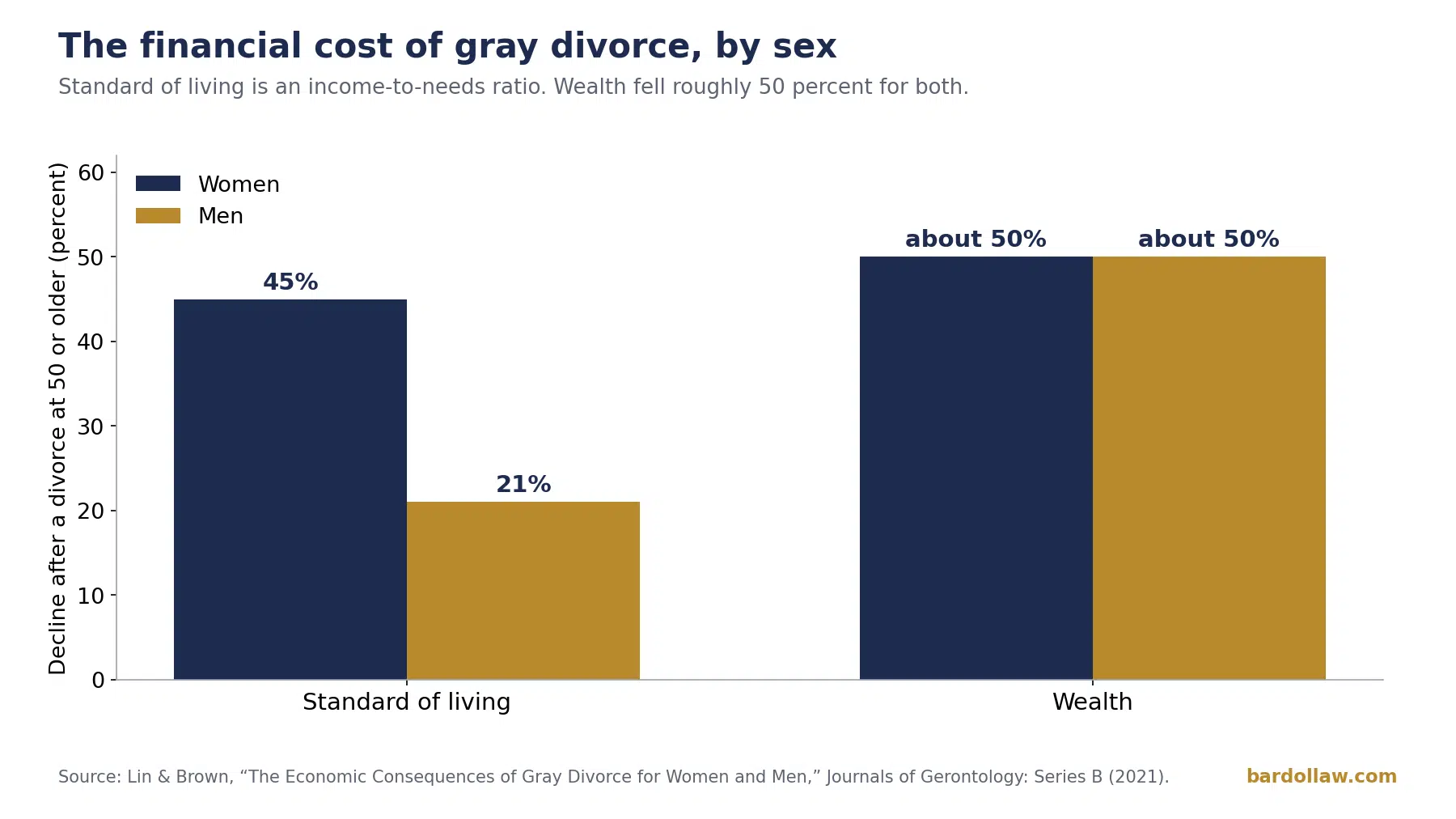
Gray divorce often happens close to retirement, with less time to rebuild. A study using national Health and Retirement Study data from 2004 to 2014 found the following (Lin and Brown, 2021).
Women’s standard of living fell 45 percent, measured as income relative to needs. Men’s fell 21 percent.
Wealth fell roughly 50 percent for both women and men.
The losses lasted. Men’s declines persisted over time. Women’s reversed mainly when they repartnered, and most did not.
New relationships after 50. About 22 percent of women and 37 percent of men formed a new partnership within 10 years of a gray divorce, more often by living together than by remarrying (Brown and colleagues, Demography, 2019).
What Missouri Law Says About Divorce After 50
No current public source we found publishes a Missouri-specific gray divorce rate. Missouri courts received 19,315 divorce filings in fiscal year 2025, 10,743 of them by couples without minor children (Missouri Judicial Report Supplement, Tables 17 and 42, and see our Missouri family law statistics), and the national research above applies to many of them. What differs by state is the law, and several Missouri rules matter most after 50.
Retirement savings. Missouri divides marital property, and retirement benefits earned during the marriage are usually part of it. Our pages on whether Missouri is a community property state, dividing retirement accounts and QDROs explain how.
Maintenance (spousal support). When setting maintenance, a Missouri court considers factors that include the length of the marriage and the age and physical and emotional condition of the spouse seeking maintenance, under section 452.335. Current law sets no formula for how long maintenance lasts. Bills proposing duration limits have been filed repeatedly. The most recent, Senate Bill 1532 (2026), would have capped maintenance at 75 percent of the length of a long marriage, but it did not advance past committee. Our spousal support page covers the rest.
Social Security. Under federal rules, a divorced spouse who is at least 62, unmarried and was married for at least 10 years may receive benefits on the former spouse’s record, without reducing what the former spouse or a new spouse receives. If the former spouse has not started benefits, the divorce must generally be at least two years old (Social Security Administration). See our Social Security and divorce page.
Health insurance before Medicare. A spouse who would lose employer group health coverage because of a divorce can usually continue it under COBRA for up to 36 months. The plan must be notified of the divorce, and must allow at least 60 days after it for that notice, but it is best given as soon as possible. The coverage often costs more, because many employers stop paying a share (U.S. Department of Labor).
Before you decide anything after a long marriage, know what Missouri law protects.
What to say, what to sign, whether to move out, how to handle the kids’ schedule. One hour with an experienced Bardol Law Firm attorney before you decide can save you from choices that are hard to undo later. You will leave understanding your rights, your options, and what to do next.
$300 · One full hour · No obligation to hire us
Why Gray Divorce Statistics Differ
Different sources report different gray divorce numbers, and many websites mix them. Before relying on a figure, check two things.
What it measures. Pew’s current series counts divorces per 1,000 married women 50 and older (3.9 in 1990 and 10.3 in 2023). Pew’s 2017 analysis counted divorces per 1,000 married people 50 and older (5 in 1990 and 10 in 2015). An earlier National Center for Family & Marriage Research series used yet another calculation (4.9 in 1990 and 10.3 in 2017). Each is accurate on its own terms, but they should not be compared with each other.
What year it covers. The share of divorces involving people 50 and older was 36 percent in 2019 and is now described as nearly 40 percent. Both numbers appear online, often without dates.
Each figure on this page names its source and year so you can judge it for yourself.
How Bardol Law Firm Helps
Bardol Law Firm handles family law and nothing else, in St. Louis County, the City of St. Louis, St. Charles County and Jefferson County. In divorces after 50, we focus on what matters most at that stage, including dividing retirement accounts and pensions correctly, maintenance after a long marriage, the timing of health coverage and Social Security, and protecting what each spouse needs for retirement. Our gray divorce page explains how we handle these cases.
Not sure how this applies to your situation?
Bardol Law Firm handles family law and nothing else, in St. Louis County, St. Louis City, St. Charles County and Jefferson County. We return calls from potential clients as quickly as possible, and usually within minutes.
Frequently Asked Questions
What is a gray divorce?
A divorce between spouses 50 or older. The rate for this age group nearly tripled from 1990 to 2008 and has stayed near that level since.
What percentage of divorces involve people over 50?
About 36 percent of people divorcing in 2019 were 50 or older, up from 8.7 percent in 1990, and researchers now describe the share as nearly 40 percent.
Is the gray divorce rate still rising?
Not nationally. It rose from 1990 to 2008 and has been relatively stable since, at 10.3 divorces per 1,000 married women 50 and older in 2023.
How long do marriages last before a gray divorce?
A median of 29 years for first marriages, according to 2022 data. About a third of people divorcing after 50 had been married at least 30 years.
Who is hurt more financially by a gray divorce?
Women, on average. Women’s standard of living fell 45 percent compared with 21 percent for men, though both lost roughly half their wealth.
Can I get Social Security on my ex-spouse’s record after a gray divorce?
Often, yes, if you were married at least 10 years, are at least 62 and are unmarried. It does not reduce your former spouse’s benefits.
Does Missouri limit how long maintenance lasts after a long marriage?
Not under current law. The court weighs factors including the length of the marriage and the age and health of the spouse seeking maintenance. Duration caps have been proposed but not enacted.
Using These Statistics
This page gives general information as of October 2026 and is not legal advice. Statistics are reported as published by the sources linked, and each source measures gray divorce in its own way.
The choice of a lawyer is an important decision and should not be based solely upon advertisements.